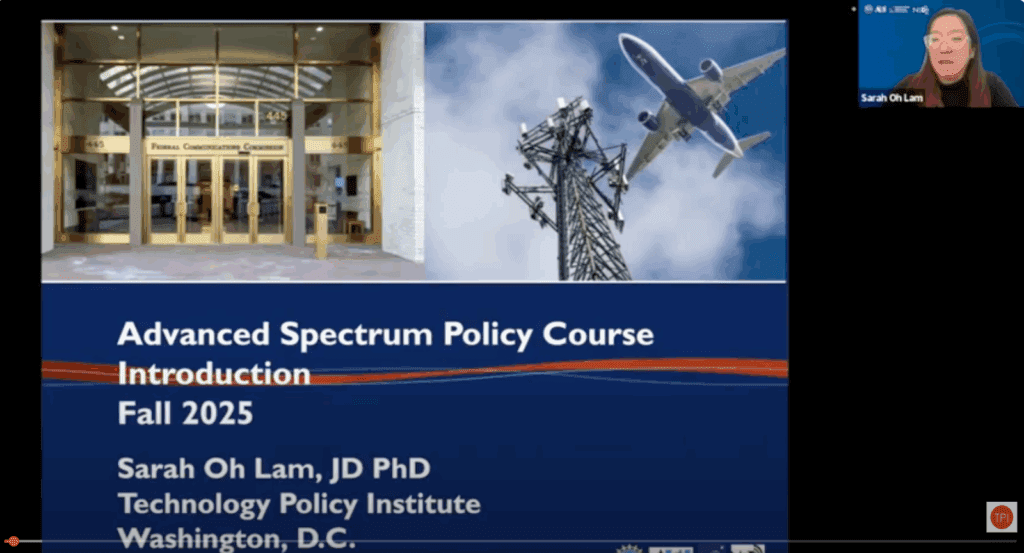
TPI Senior Fellow Sarah Oh Lam just finished recording a series of video lectures for the National Radio Astronomy Observatory (NRAO) on Advanced Spectrum Policy, a one credit graduate course on federal and international spectrum policy (Fall 2025).
The Advanced Spectrum Policy videos are available on TPI’s YouTube channel, and the course reader and syllabus are below.
Course Materials:
Advanced Spectrum Policy Course Reader
Slides:
Introduction: Advanced Spectrum Policy Course
Lecture 1: NRAO Panel Discussion
Lecture 2: Federal Spectrum Policy
Lecture 3: FCC and NTIA and OSTP
Lecture 4: FCC Rulemaking Process
Lecture 5: Congressional Involvement in Spectrum Policy
Lecture 6: International Spectrum Policy
Lecture 7: Competition and New Use Cases
For more on radio spectrum policy, see also Sarah Oh Lam’s Spectrum Policy Primer (Spring 2023) and topics covered in the TPI Winter Spectrum Series of 2025 and 2024. Stay tuned for updates on the TPI Winter Spectrum Series 2026!
==
Other notes (ignore)
Introducing the Advanced Spectrum Policy Course, a graduate-level course prepared for the National Radio Astronomy Observatory (NRAO), National Science Foundation (NSF) education program. This course includes 8 lectures and course materials and provides an in-depth exploration of how radio spectrum is allocated, regulated, and shared among scientific, commercial, and governmental users.
Video Playlist (8 videos): Advanced Spectrum Policy Lectures (NRAO Course)
- Introduction: Advanced Spectrum Policy Course https://www.youtube.com/watch?v=QoYm_8a1Q8w&list=PLIbQnBe9lRS_YjEJyMEqm_QNFbmld5_ko&index=1
- Lecture 1: NRAO Panel Discussion
- Lecture 2: Federal Spectrum Policy
- Lecture 3: FCC and NTIA and OSTP
- Lecture 4: FCC Rulemaking Process
- Lecture 5: Congressional Involvement in Spectrum Policy
- Lecture 6: International Spectrum Policy
- Lecture 7: Competition and New Use Cases

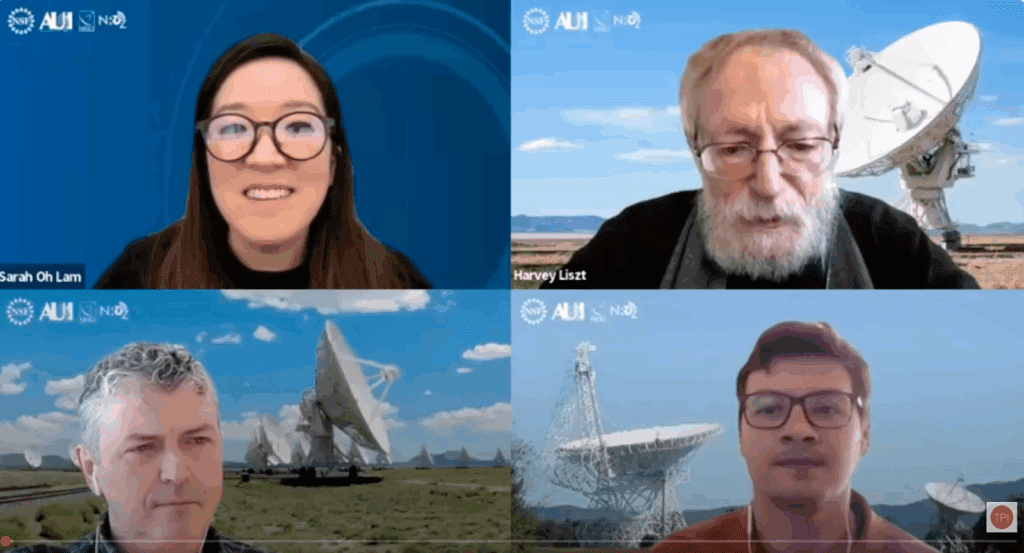
Taught by Sarah Oh Lam, J.D., Ph.D., the curriculum begins with a panel of experts discussing the unique challenges faced by radio astronomy. Lectures then discuss the basics of U.S. federal spectrum management, highlighting the National Spectrum Strategy of 2024, the roles of the Federal Communications Commission (FCC), the National Telecommunications and Information Administration (NTIA), and the White House Office of Science and Technology Policy (OSTP). Graduate students will examine the FCC’s rulemaking process, from initiating proceedings under the Administrative Procedure Act to drafting persuasive public comments, while also considering Congressional oversight and landmark statutes that have shaped modern spectrum auctions and reallocation. The course includes material on international coordination through the International Telecommunication Union’s (ITU) World Radiocommunication Conference (WRC) and regional bodies such as CITEL. It also investigates emerging technologies and competitive dynamics, experimental licensing, and spectrum sharing frameworks for next-generation wireless networks.
Current policy debates, case studies, and assignments that require applying legal, technical, and economic reasoning are included. Course materials cover how national and international policies, scientific needs, and market forces intersect to govern the electromagnetic spectrum—knowledge crucial for careers in telecommunications, space science, and technology policy.
Course Materials
Download Course Reader (158 pages) (PDF) https://storage.googleapis.com/advanced-spectrum-policy-course/AdvSpectrumPolicy_Fall2025_CourseReader_SL.pdf
Table of Contents
1. Lecture 1: Panel on Radio Astronomy Spectrum Policy and Management 4
1.1. Learning Objectives 5
1.2. Radio Astronomy’s Unique Spectrum Challenges 6
1.2.1. The National Radio Quiet Zone 6
1.2.2. Coordination Beyond Protected Zones 8
1.2.3. Types of Interference 8
1.2.4. Innovative Private Coordination Solutions 8
1.2.5. The Sensitivity Challenge 8
1.3. Space Congestion and Growing Challenges 9
1.3.1. Unintended Electromagnetic Radiation 9
1.3.2. Coordination Complexities with Multiple Operators 9
1.3.3. New Interference Calculation Methods 9
1.4. Radar Interference and Coordination 10
1.4.1. NRAO’s Radar Development 10
1.4.2. Commercialization of Federal Spectrum 10
1.4.3. Competing Interests in Spectrum Allocation 10
1.5. Other Topics 11
1.5.1. Spectrum Encroachment at Higher Frequencies 11
1.5.2. The Next Generation Very Large Array 11
1.5.3. Consumer Electronics and Increasing RFI 12
1.5.4. International Coordination Frameworks 12
1.6. In the News 13
1.7. Assignment 13
1.8. Reading List 14
2. Lecture 2: Federal Spectrum Policy 14
2.1. Learning Objectives 15
2.2. National Spectrum Strategy 2024 15
2.2.1. National Spectrum Strategy 2024 (Nov. 13, 2023) 15
2.2.2. National Spectrum Strategy Implementation Plan 2024 (Mar. 12, 2024) 18
2.2.3. National Spectrum Research & Development Plan (Oct. 2024) 20
2.2.4. 2024 NTIA Spectrum Symposium 26
2.3. Congressional Oversight 27
2.3.1. U.S. House of Representatives Energy and Commerce Committee, Subcommittee on Communications 27
2.3.2. Senate Commerce Committee Subcommittee on Telecommunications 28
2.4. Research Institutions 31
2.5. In the News 33
2.6. Assignment 34
2.7. Reading List 35
3. Lecture 3: FCC and NTIA and OSTP 36
3.1. Learning Objectives 36
3.2. Federal Communications Commission (FCC) 36
3.2.1. FCC Organizational Chart 37
3.2.2. Universal Licensing System Database (ULS) 39
3.2.3. Electronic Comment Filing System (ECFS) 40
3.2.4. Spectrum Auctions 42
3.3. National Telecommunications and Information Administration (NTIA) 43
3.3.1. NTIA Organization Chart 43
3.3.2. IRAC 46
3.3.3. Spectrum Table NTIA 49
3.3.4. NTIA CSMAC 51
3.4. FCC and NTIA Memorandum of Understanding (Aug. 2022) 53
3.5. White House Office of Science & Technology Policy (OSTP) 55
3.6. In the News 57
3.7. Assignment 57
3.8. Reading List 58
4. Lecture 4: FCC Rulemaking Process 58
4.1. Learning Objectives 58
4.2. Rulemaking Process 59
4.2.1. Administrative Procedure Act 59
4.2.2. Starting a Rulemaking 60
4.2.3. Judicial Review of Agency Rulemaking 63
4.3. Filing Comments 67
4.3.1. Drafting and Submitting a Comment 72
4.3.2. Preparing Effective Comments 74
4.4. Case Study: Broadcast Incentive Auction 76
4.5. In the News 95
4.6. Assignment 99
4.7. Reading List 99
5. Lecture 5: Congressional Involvement in Spectrum Policy 100
5.1. Learning Objective 100
5.2. Statutes 100
5.2.1. Spectrum Auction Reauthorization 100
5.2.2. Commercial Spectrum Enhancement Act of 2004 (P.L. 108-494) (created the Spectrum Relocation Fund) 103
5.2.3. Spectrum Act of 2012 (P.L. 112-96) (established the Broadcast Incentive Auctions of 2016) 103
5.2.4. Spectrum Pipeline Act of 2015 (P.L. 114-74) 104
5.2.5. MOBILE NOW Act of 2018 (P.L. 115-141) 105
5.3. Congressional Budget Office Scoring 106
5.3.1. Spectrum Valuation 108
5.4. In the News 109
5.5. Assignment 113
5.6. Reading List 113
6. Lecture 6: International Spectrum Policy 114
6.1. Learning Objectives 115
6.2. International Telecommunications Union World Radio Conference 115
6.2.1. WRC-23 119
6.2.2. WRC-27 122
6.2.3. CITEL PCC.II 123
6.3. IEEE and Other Standards Bodies 126
6.4. In the News 130
6.5. Assignment 134
6.6. Reading List 134
7. Lecture 7: Competition and New Use Cases 135
7.1. Learning Objective 135
7.2. FCC Experimental Licensing System (ELS) 135
7.3. Citizens Broadband Radio Service 141
7.3.1. Tiered Access Model 141
7.3.2. Auction 105 Results 143
7.3.3. CBRS Device Deployment 148
7.4. In the News 153
7.5. Assignment 155
7.6. Reading List 155
8. Mid-Term Exam and Final Exam – Without Answers 155
8.1. Mid-Term Exam – True or False 155
8.2. Final Exam – True or False 156
9. Mid-Term Exam and Final Exam – With Answers 157
9.1. Mid-Term Exam 157
9.2. Final Exam 158
10. Essay Assignment 161

Sarah Oh Lam is a Senior Fellow at the Technology Policy Institute. Oh completed her PhD in Economics from George Mason University, and holds a JD from GMU and a BS in Management Science and Engineering from Stanford University. She was previously the Operations and Research Director for the Information Economy Project at George Mason School of Law. She has also presented research at the 39th Telecommunications Policy Research Conference and has co-authored work published in the Northwestern Journal of Technology & Intellectual Property among other research projects. Her research interests include law and economics, regulatory analysis, and technology policy.