
FCC Chairman Brendan Carr has called for a “top to bottom” review of the Universal Service Fund. His best defensive move is to preserve a rare USF success that happened fifteen years ago and has quietly been reducing the real burden of High Cost support. His more ambitious task is to confront the political economy that blocks structural reform and leaves rural customers dependent on permanently subsidized providers. To do that, we proposed VISTA, a competitive auction to retire perpetual subsidies that would improve rural service and save consumers money.
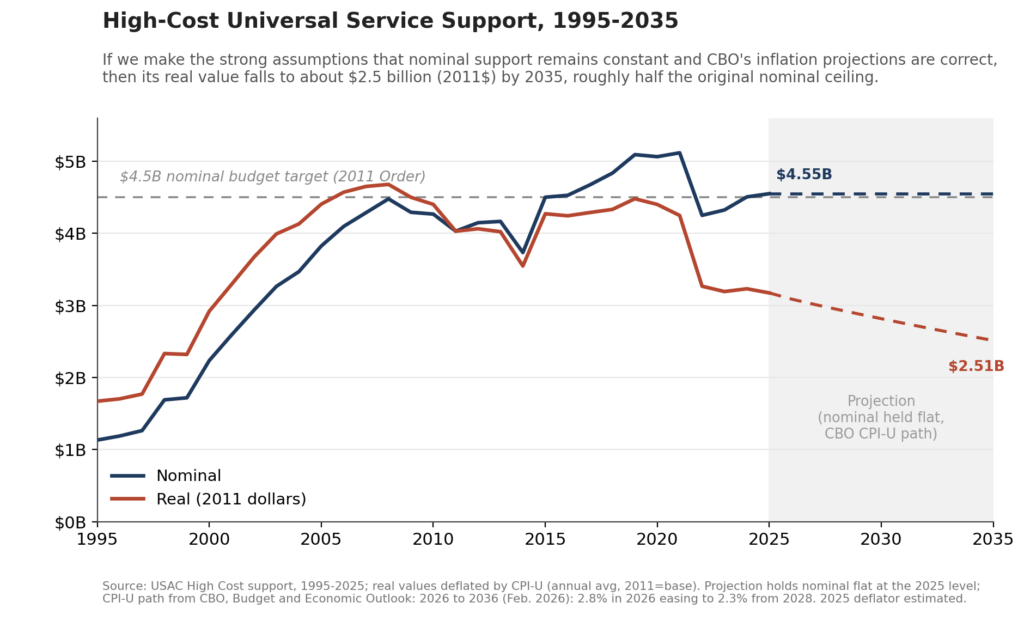
Championships are built on defense, and this defense has held for fifteen years. The 2011 USF/ICC Transformation Order capped the High Cost program at $4.5 billion per year in nominal dollars. In 2025 the program disbursed $4.55 billion, almost exactly the cap. But $4.5 billion today isn’t what it once was. Holding the nominal cap has let inflation cut its real value by nearly one-third over the past 15 years. Milton Friedman observed that inflation is taxation that can be imposed without legislation. Friedman meant this as a warning about the pernicious effects of inflation on society. Applied to an inefficient subsidy program, the same mechanism that harms society becomes helpful. The cap turned out to be a nominal anchor that legislated its own real decline. If nominal disbursements stay flat and inflation runs at 2.5 percent, the program will lose another 22 percent of its real value by 2035, meaning real spending will have decreased by about half. This kind of “reform” is unsatisfying and slow, but it is meaningful. Staying on track mostly means resisting pressure to increase spending.
The new High Cost NPRM asks serious questions about the future of legacy support. But it does not confront the political economy that has frustrated such reforms for decades. The problem is not only that the Commission pays rural carriers through outdated mechanisms. It’s that those mechanisms sustain a concentrated constituency whose survival depends on preserving them. They are organized, well-represented in Washington, and disciplined about defending the funding flow. Any reform that threatens that flow will predictably produce determined opposition.
New programs illustrate both the pressure for additional rural support and the importance of keeping new commitments finite. RDOF awarded roughly $9 billion over ten years, and the 5G Fund (still awaiting auction) would make up to another $9 billion available through a time-limited auction. On one hand, these programs have allowed the Commission to succumb to pressure for more funding despite the cap. On the other hand, the programs were finite commitments that tested competitive award mechanisms, while the open-ended commitments remained nominally constant. That is, the nominal cap forced the Commission to accommodate new priorities without allowing permanent obligations to ratchet upward.
There is a way to fix the underlying problem. While defense holds the line, our offense is VISTA, the Voluntary IP Service Transition Auction, modeled on the broadcast incentive auction. Small rural carriers set their own buyout prices and exit. New providers, likely including LEO satellite operators, fixed wireless providers, electric cooperatives, and cable operators serving adjacent areas, compete to take over service obligations with time-limited support. The auction closes if the combined cost of buyouts and replacement service is less than the net present value of continuing current subsidies in an area. If the auction does not meet that condition, the status quo continues, leaving the fund at no risk. But if it succeeds, the fund saves money, rural customers get a competitive path to better service, and incumbent carriers receive an orderly, compensated exit instead of an open-ended reason to block reform.
The case for VISTA does not require entrants to be more efficient than incumbents, although that is likely. It comes from converting a perpetual subsidy stream into a finite one that has a lower net cost. The savings from converting the first into the second are large enough to fund substantial exit payments to incumbents. VISTA would resolve the structural problem on a timeline of years rather than decades by giving the existing constituency a financial reason to support reform rather than block it. ITIF has separately proposed phasing out the High Cost program over five years and replacing it with consumer vouchers.
VISTA faces the same political economy that has blocked every prior attempt to dismantle this constituency. Neither it nor the ITIF alternative is likely soon. Realism means protecting the slow path, which is already on track. Inflation steadily reduces what the cap can buy. Economic growth makes the High Cost program a shrinking share of the broader broadband economy. The program’s relevance is fading in proportion to private investment in low-earth-orbit satellite and fixed wireless, neither of which existed in its current form when the High Cost program was conceived. Every year without a structural fix does some of the work that VISTA would do faster.
This delay is not costless. Some carriers will limp along when an orderly exit would be cleaner. The slow decline is a second-best outcome. But after fifteen years, it is hard to argue the trajectory is wrong.
The caveat is how the USF is funded, which is now a roughly 37 percent tax, officially called the “contribution factor,” on interstate and international telecommunications revenues, up from about six percent in 2000. That increase has little to do with USF spending, which has been roughly stable in nominal terms for more than a decade. It reflects a tax base designed for the long-distance era and increasingly disconnected from how consumers communicate today. The funding mechanism is plainly broken and should be replaced. But changing how the government raises the money is no substitute for spending discipline. Without the cap, a less dysfunctional funding mechanism would simply make it easier to expand subsidies when beneficiaries lobby for them.
Carr’s “top to bottom” review will be most successful if it preserves the nominal cap, adopts mechanisms like VISTA to accelerate the transition, and plans for the structural change already underway. That is harder than running a procedural cleanup. It is also the only approach that turns fifteen years of cap stability into deliberate good policy.

Gregory Rosston is Director of the Public Policy Program at Stanford University and Senior Fellow at the Stanford Institute for Economic Policy Research. He is also a Lecturer in Economics and Public Policy at Stanford University where he teaches courses on competition policy and strategy, intellectual property, and writing and rhetoric. Rosston served as Deputy Chief Economist at the Federal Communications Commission working on the implementation of the Telecommunications Act of 1996 and he helped to design and implement the first ever spectrum auctions in the United States. He co-chaired the Economy, Globalization and Trade committee for the Obama campaign and was a member of the Obama transition team. He has served as a consultant to various organizations including the World Bank and the FCC, and as a board member and advisor to high technology, financial, and startup companies. Rosston received his Ph.D. in Economics from Stanford University specializing in the fields of Industrial Organization and Public Finance and his A.B. with Honors in Economics from University of California at Berkeley.

Scott Wallsten is President and Senior Fellow at the Technology Policy Institute, a Policy Fellow at the Stanford Institute for Economic Policy Research (SIEPR), and a senior fellow at the Georgetown Center for Business and Public Policy. He is an economist with expertise in industrial organization and public policy, and his research focuses on competition, regulation, telecommunications, the economics of digitization, and technology policy. He was the economics director for the FCC's National Broadband Plan and has been a lecturer in Stanford University's public policy program, director of communications policy studies and senior fellow at the Progress & Freedom Foundation, a senior fellow at the AEI–Brookings Joint Center for Regulatory Studies, a resident scholar at the American Enterprise Institute, an economist at the World Bank, and a staff economist at the U.S. President's Council of Economic Advisers. He holds a PhD in economics from Stanford University.