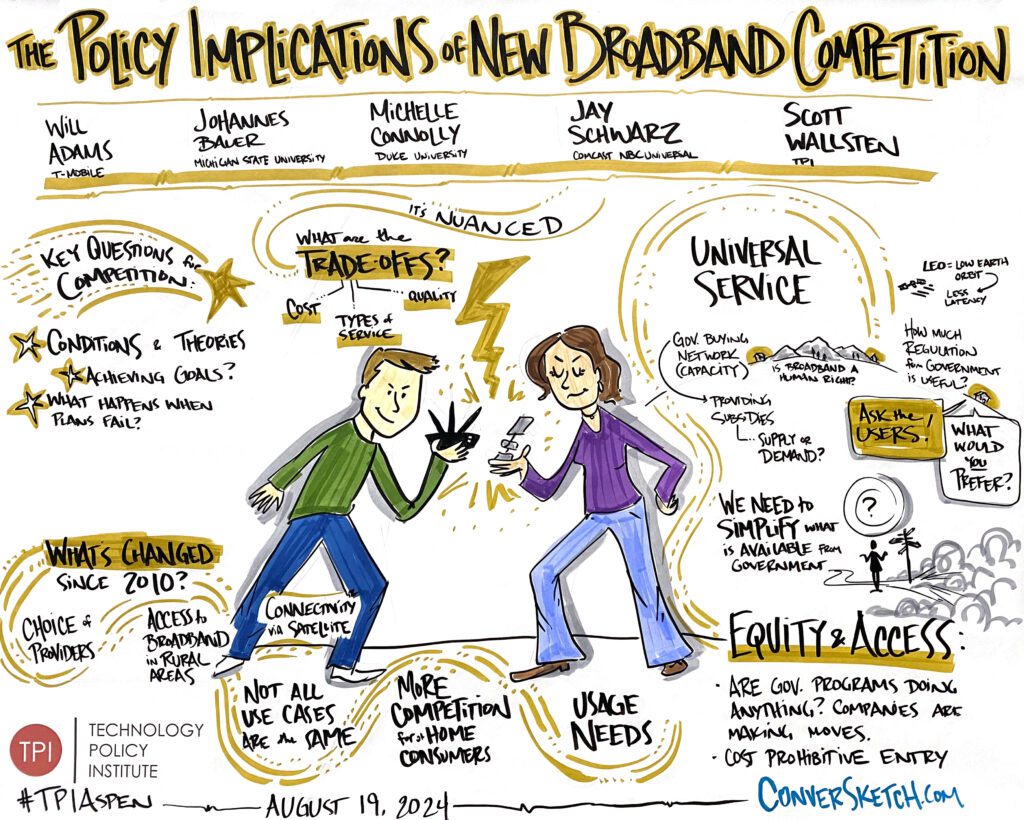
Panelists: Will Adams, Johannes Bauer, Michelle Connolly, Jay Schwarz
Moderator: Scott Wallsten
Key takeaways from the panel:
- 5G fixed wireless and low earth orbit satellites like Starlink are competing with traditional broadband providers and increasing connectivity in rural areas. Fixed wireless in particular has grown rapidly, accounting for 8.6 million new broadband subscribers.
- Some expressed concern about the affordability of these new options and thus whether they can help with the income digital divide. Panelists discussed the merits of supply (infrastructure) subsidies versus direct demand subsidies (vouchers) to increase accessibility as critical services, like telehealth, move online.
- Government programs, like the Universal Service Fund and BEAD, largely favor fiber networks over more flexible and immediate connectivity solutions like fixed wireless or LEO satellites. Fiber is the gold standard, but is expensive to deploy and takes time to deploy in rural areas.
- A balanced approach to technology choice would try to ensure that the expected net present value of benefits exceeds the expected net present value of costs. That takes into account connectivity quality and how much people value incremental quality, time to deployment, and the costs of providing, maintaining, and upgrading the connection in the future. Meanwhile, government policy should evolve to reflect the potential of new technologies like Starlink as legitimate competitors to traditional broadband given their potential to provide affordable and widespread access.
You can watch videos or read full transcripts of each panel, including this one, on TPI’s YouTube channel. Below is a live illustration of this panel provided by graphic artist Karina Branson of CoverSketch. Stay tuned for more panel summaries from 2024’s Aspen Forum!