
The COVID-19 pandemic has highlighted the importance of broadband connections and the ways that not being connected can worsen inequality. While policymakers struggle to find effective methods of increasing adoption, the pandemic itself appears to have helped make some strides in closing the divide.
Specifically, based on data from the largest ISPs’ quarterly 10Q SEC filings, the upward trend in the number of fixed line connections accelerated once the pandemic began, as the figure below shows. From Q3 2011 through Q3 2019, the number of fixed connections from these companies increased at approximately a three percent annual compound growth rate. During the pandemic, from Q3 2019 through Q3 2020 (the most recent data available), the number of connections increased by about five percent.
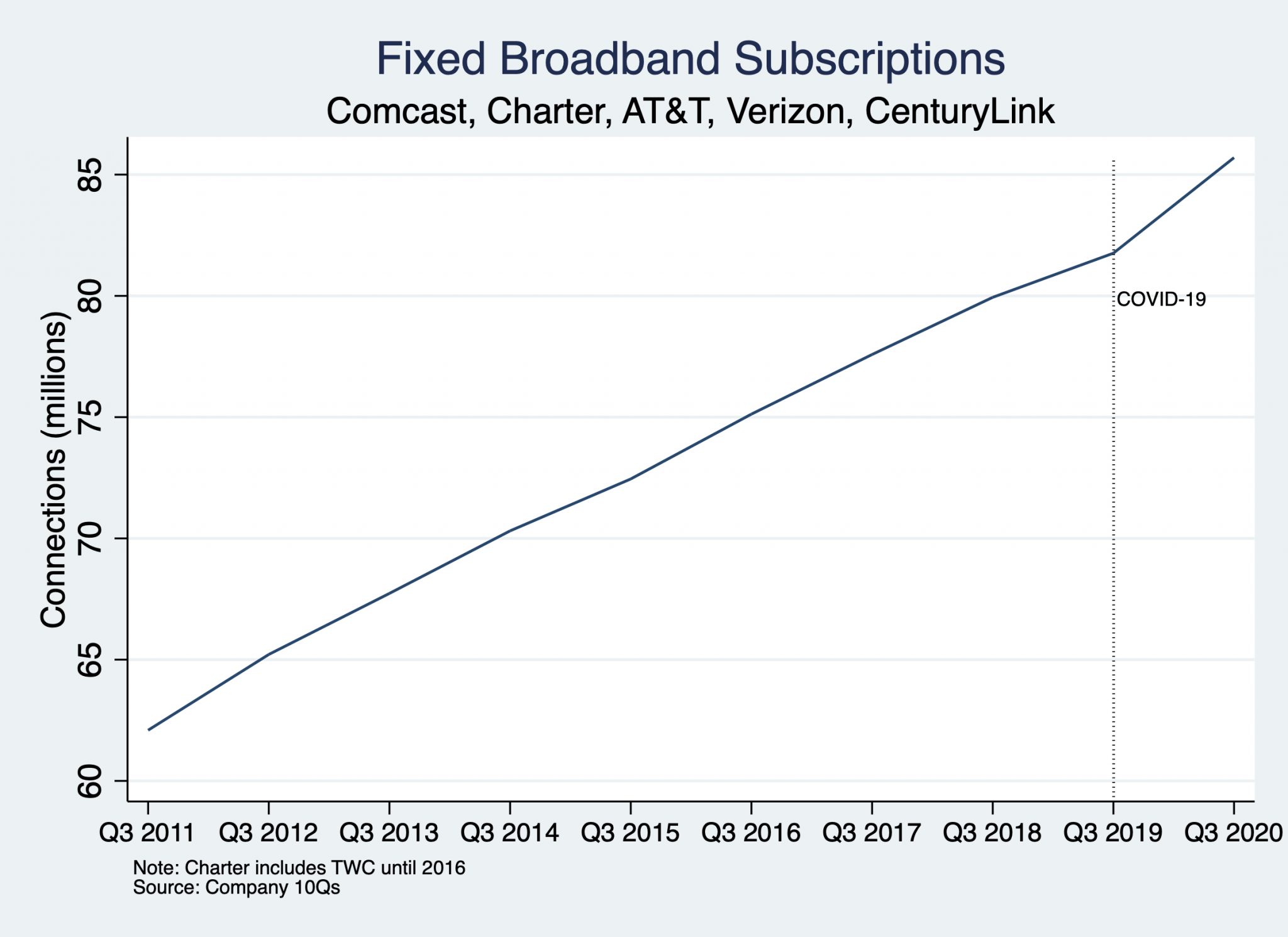
The accelerated adoption rate could be coincidental, of course, but is likely due to increased household demand as broadband became more important for work, education, entertainment, and other aspects of daily life, as well as discounted plans and pledges from ISPs to not cut off connections for nonpayment.
None of this is meant to imply that low-income adoption and rural availability are no longer problems. They are. Instead, it simply suggests that we may emerge from the pandemic with a somewhat smaller divide than existed when the pandemic began and that we still need research to help figure out what approaches are likely to be effective in bridging the remaining divide.

Scott Wallsten is President and Senior Fellow at the Technology Policy Institute, a Policy Fellow at the Stanford Institute for Economic Policy Research (SIEPR), and a senior fellow at the Georgetown Center for Business and Public Policy. He is an economist with expertise in industrial organization and public policy, and his research focuses on competition, regulation, telecommunications, the economics of digitization, and technology policy. He was the economics director for the FCC's National Broadband Plan and has been a lecturer in Stanford University's public policy program, director of communications policy studies and senior fellow at the Progress & Freedom Foundation, a senior fellow at the AEI–Brookings Joint Center for Regulatory Studies, a resident scholar at the American Enterprise Institute, an economist at the World Bank, and a staff economist at the U.S. President's Council of Economic Advisers. He holds a PhD in economics from Stanford University.