
A common lament lately is the increasing partisanship in our government institutions. No longer do politicians reach across party lines to reach compromises with their ideological opposites. One might expect our expert, independent agencies to buck that trend. Unfortunately, the Federal Communications Commission, at least, seems to be following Congress down the partisan divide.
Voting data from the FCC shows that the share of commissioner votes on orders split along party lines is higher in Chairman Tom Wheeler’s commission than under the average of either Republican or Democratic chairmen back to Reed Hundt in 1994.
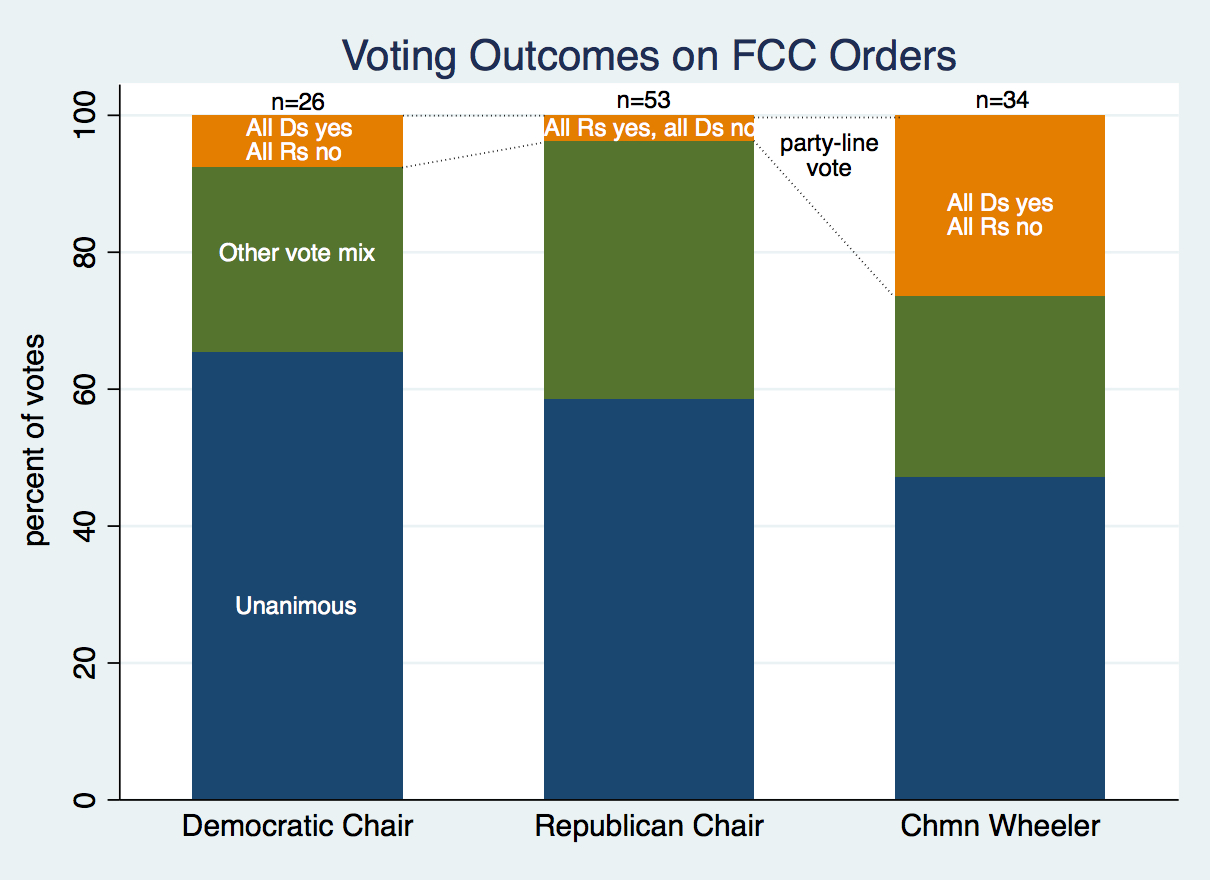
In the past, votes at the FCC tended to be unanimous—under both Democratic and Republican chairs more than half of votes on major orders were unanimous (about 65 percent for Democrats and 58 percent for Republicans). Under Chairman Wheeler that has dropped to 47 percent.
Perhaps more worrisome is the increase in votes that split along party lines. Under Democrats, about eight percent of votes on major orders split along party lines. Under Republicans, only four percent split on party lines. Under Chairman Wheeler, 26 percent of votes on orders have passed with yes votes from the Democratic Chairman, Commissioner Rosenworcel, and Commissioner Clyburn, with Republican Commissioners O’Rielly and Pai dissenting. The difference from the past is stark.
This analysis comes with some important caveats to consider. Most importantly, the comparisons are not quite apples-to-apples.
For Chairmen prior to Mr. Wheeler the analysis considers only “major” orders, as defined by the Chairmen themselves upon their exit from the Commission.[1] Such a list, obviously, does not yet exist for the current Chairman. Thus, while the shares for Democrats and Republicans are based on major orders, the shares for Chairman Wheeler are from all orders voted on under his tenure so far. Arguably, this difference means the analysis is biased towards finding more unanimous votes under the current chairman since it includes uncontroversial orders like one considered at the November 2015 open meeting on “hearing aid compatibility for wireless voice technologies”[2] or at the May 2015 open meeting that made “Make Deaf-Blind Equipment Distribution Program Permanent.”[3] On the other hand, to the extent that former chairmen cared about including the ability to cultivate unanimous votes they might be more inclined to exclude from their list of major orders those that were not unanimous.
Nevertheless, these data suggest that the FCC is, like the rest of the country, is more split along party lines than it has been in recent history.
[1] For a full definition and discussion, see my 2015 paper, “Administrative Procedures, Bureaucracy, and Transparency: Why Does the FCC Vote on Secret Texts?” Available here.
[2] https://www.fcc.gov/document/fcc-ensures-hearing-aid-compatibility-wireless-voice-technologies-0
[3] https://www.fcc.gov/document/national-deaf-blind-equipment-distribution-program-order

Scott Wallsten is President and Senior Fellow at the Technology Policy Institute, a Policy Fellow at the Stanford Institute for Economic Policy Research (SIEPR), and a senior fellow at the Georgetown Center for Business and Public Policy. He is an economist with expertise in industrial organization and public policy, and his research focuses on competition, regulation, telecommunications, the economics of digitization, and technology policy. He was the economics director for the FCC's National Broadband Plan and has been a lecturer in Stanford University's public policy program, director of communications policy studies and senior fellow at the Progress & Freedom Foundation, a senior fellow at the AEI–Brookings Joint Center for Regulatory Studies, a resident scholar at the American Enterprise Institute, an economist at the World Bank, and a staff economist at the U.S. President's Council of Economic Advisers. He holds a PhD in economics from Stanford University.
