
February 8, 2016 is the 20th anniversary of the 1996 Telecommunications Act, whose primary goal was creating a “procompetitive, deregulatory framework.” In this blog post, I consider one indicator near and dear to Washington, DC: How did it affect lawyers? (And what might that answer say about how well the Act met its goals?)
It’s not obvious what would be the best data on corporate legal activity or how to compile it, but one indicator is the number of Federal Communications Bar Association (FCBA) members. The FCBA, founded in 1936, describes itself as “an organization of attorneys and other professionals, including engineers, consultants, economists and government officials, involved in the development, interpretation and practice of communications law and policy.” In other words, if you want to practice communications law, you join the FCBA.
The earliest data I could find showed the FCBA with 223 members in 1943, increasing to 517 in 1959. In 1991, it had “about 2000” members. In 1996 that increased to 2850 and in 2001 peaked at 3,450 members (Figure 1).
Figure 1: Number of FCBA Members by Year[1]
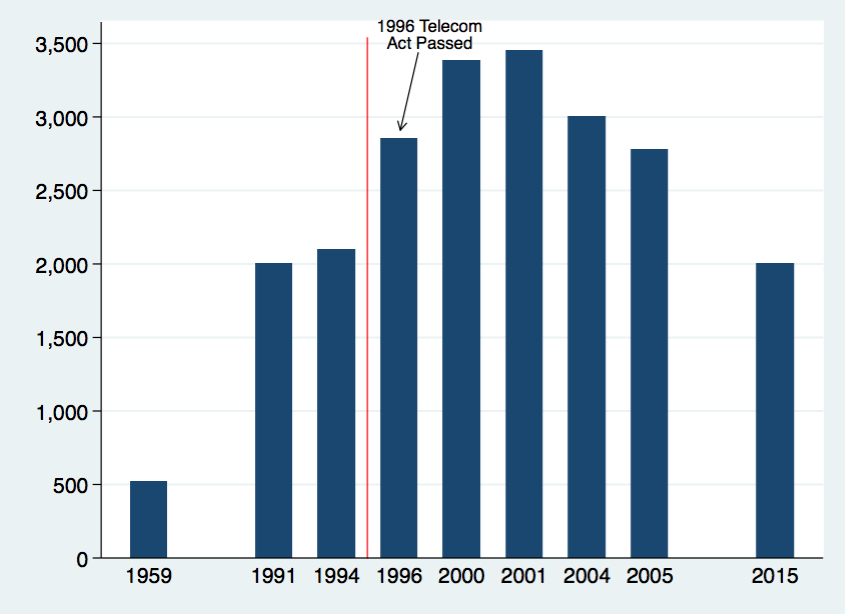
These data are imprecise—for example, today the FCBA reports having “over 2000” members. Regardless, they show that the 1996 Act appeared to generate work for about 1000 additional telecommunications lawyers for a decade. This increase suggests that TA96 did not lead to deregulation, at least to the extent to which deregulation should result in less interaction between industry and the regulator.
Based on several heroic[2] assumptions, that’s about $10 billion worth of legal services generated by the Act.[3] To be fair to the lawyers, the legislation probably could never have worked in practice[4] without lawyers stampeding in to figure out how to implement the thing.[5]
Whether the Act brought net benefits is another question, but on this anniversary lawyers, academics, think tankers, and advocacy groups should raise a toast in honor of the complex and ambiguous law that brought them so much good fortune.
[1] Sources: Data from 1959 and earlier are from the minutes of FCBA meetings recorded in the FCBA Bar Journal. Later data come from versions of the FCBA website stored on the Internet Archive (archive.org) and various newspaper articles.
[2] i.e., questionable: see footnote 3.
[3] The ABA estimated that in 2012 the average billing rate for law firm partners was $536 per hour and $370 for associates (http://www.abajournal.com/news/article/average_hourly_billing_rate_for_partners_last_year_was_727_in_largest_law_f/). At $370 per hour, 1000 lawyers billing 40 hours per week, 50 weeks a year for 10 years is about $7.4 billion. At $536 per hour the total comes to $10.7 billion. The true total might be higher or lower. DC communications attorneys might bill, on average, more or less than 40 hours per week on communications issues and probably charge higher rates than the national average. The estimate does not include time by paralegals, support staff, or experts hired to support regulatory filings.
[4] Some would argue it didn’t.
[5] And it’s only a net economic cost to the extent that it represents a net increase in the total number of lawyers and not a transfer from another industry to telecommunications.

Scott Wallsten is President and Senior Fellow at the Technology Policy Institute and also a senior fellow at the Georgetown Center for Business and Public Policy. He is an economist with expertise in industrial organization and public policy, and his research focuses on competition, regulation, telecommunications, the economics of digitization, and technology policy. He was the economics director for the FCC's National Broadband Plan and has been a lecturer in Stanford University’s public policy program, director of communications policy studies and senior fellow at the Progress & Freedom Foundation, a senior fellow at the AEI – Brookings Joint Center for Regulatory Studies and a resident scholar at the American Enterprise Institute, an economist at The World Bank, a scholar at the Stanford Institute for Economic Policy Research, and a staff economist at the U.S. President’s Council of Economic Advisers. He holds a PhD in economics from Stanford University.